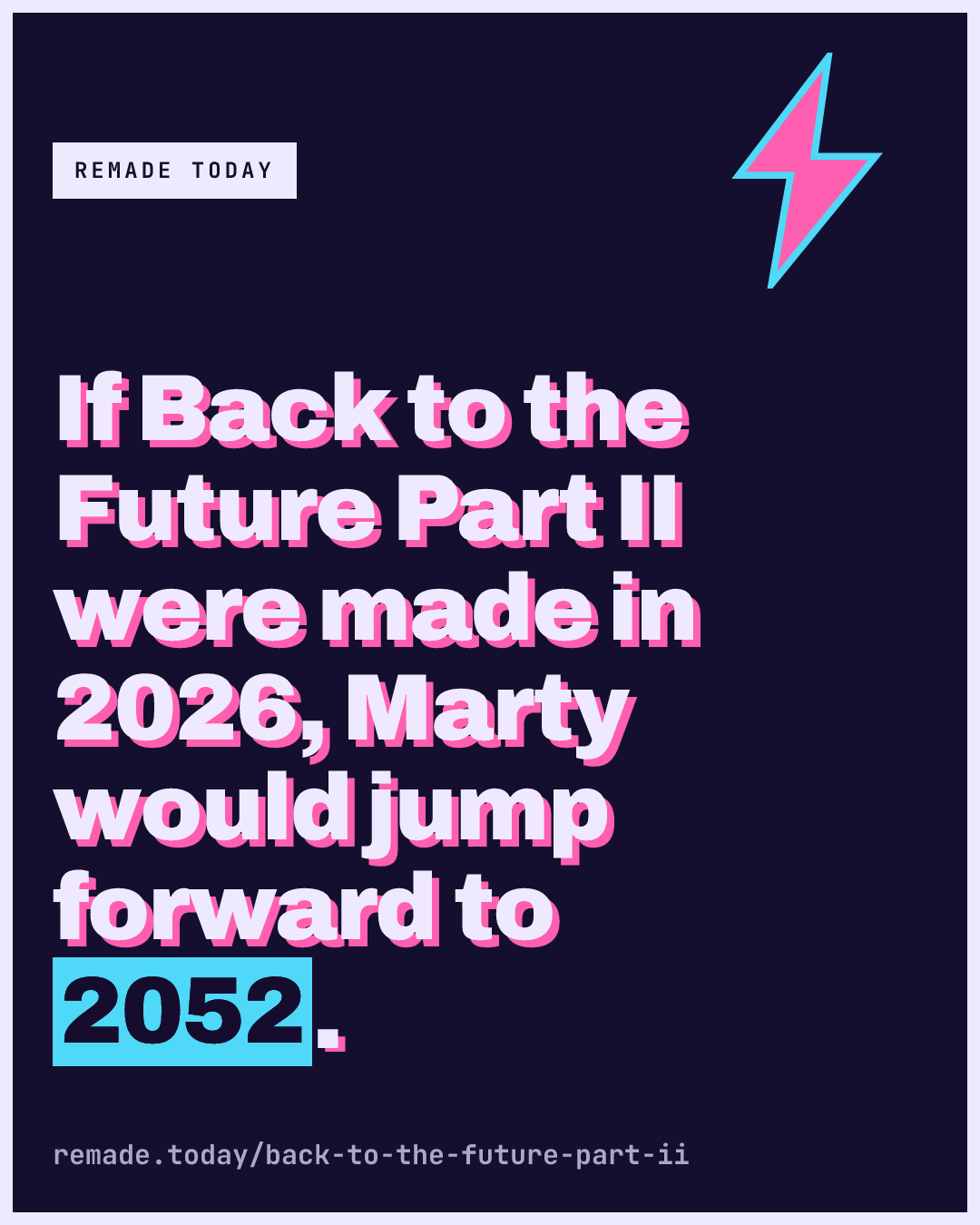
If Back to the Future Part II were made in 2026, Marty would jump forward to 2052.
The short answer
Back to the Future Part II came out in 1989 and sent Marty 26 years forward, to 2015. Made in 2026 instead, the same jump would land him in 2052.
The arithmetic
What year would Back to the Future Part II be set in if it were made in 2026?
When it was made
If it were made in 2026
- Released
- 1989
- Originally set in
- 2015
- The gap
- 26 years
- Recalculated for 2026
- 2052
Also in this one
The other dates in Back to the Future Part II
The return to 1955
19551992
34 years before release. catalog.afi.com, en.wikipedia.org
Verified, sourced
Back to the Future Part II, in 7 facts
Zemeckis kept a straight face about the hoverboards, telling interviewers they were real and had simply never been released to the public because of parental complaints about safety. Source
Crispin Glover did not return as George McFly after a dispute over money. Another actor was fitted with a false chin, nose and cheekbones to resemble him, and Glover's lawsuit led to clauses in Screen Actors Guild agreements covering the unauthorised reproduction of a performer's likeness. Source
It was shot back-to-back with Part III, a decision that saved between $10 and $15 million of the two films' combined $80 million budget. Principal photography began in February 1989. Source
For six weeks of production Michael J. Fox filmed nights on this while taping the final season of Family Ties during the day — the same arrangement he had worked through on the first film. Source
Marty's self-lacing Nike trainers were a prop invention. Nike later made the shoe. Source
The holographic shark advertising Jaws 19 is one of the film's few pieces of computer-generated imagery — a brief joke in a film built almost entirely out of practical effects. Source
Made for $40 million, it took $333 million worldwide and was nominated for the Academy Award for Visual Effects. Source
The point
What the shift reveals
The first film picked a gap and stuck to it. This one picked a date, which is a different kind of bet — and the only one of the two that can be lost.
26 years was near enough that the audience would still be around to mark the paper. That was the joke’s whole engine: not a distant future but a plausible one, close enough to argue with, furnished with things you could imagine your own town getting. The film even hedged, keeping the flying cars comfortably absurd while the small stuff — video calls, wall-sized screens, a pair of trainers that do up themselves — turned out to be roughly on time.
Move the window to 2026 and the target becomes 2052. The distance is unchanged; what changes is that the marking is still to come. Every near-future film lives in that gap between release and reckoning, and the gap is always the same length. Back to the Future Part II simply had the nerve to name the day, and then outlived it.
Asked and answered
Questions people ask
- What year does Marty travel to in Back to the Future Part II?
- 2015. He leaves the film's present, 1985, and arrives 26 years later, on 21 October.
- What year would he travel to if the film were made today?
- 2052. The jump is fixed at 26 years, so measured from 2026 it reaches 2052 rather than 2015.
- How far into the future did Back to the Future Part II look?
- 26 years, from 1989 to 2015 — close enough that most of its first audience expected to be there for it.
- Has the future in Back to the Future Part II happened yet?
- It has. 2015 is now 11 years in the past, which is why every anniversary brings another article counting up the hoverboards.
Keep going