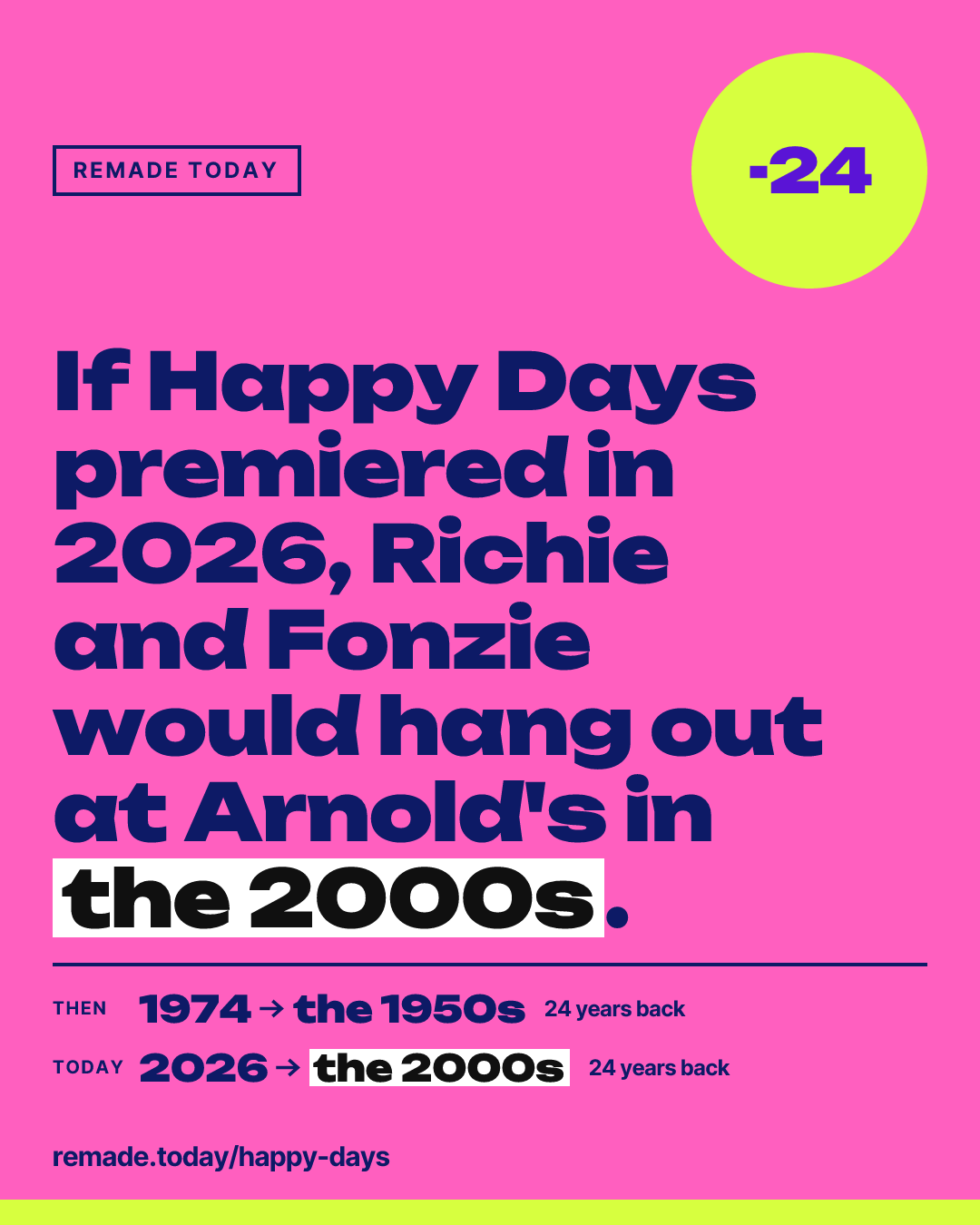
If Happy Days premiered in 2026, Richie and Fonzie would hang out at Arnold's in the 2000s.
The short answer
Happy Days premiered in 1974 and was set in the 1950s, about 24 years earlier. Made today, in 2026, the same reach back would put Richie, Fonzie and the diner in the 2000s.
When it was made
If it were made in 2026
The arithmetic
Same 24 years. Different starting line.
Sources disagree: The show never fixed a year and its calendar drifted. Wikipedia says the first season "likely" takes place in 1955 on the evidence of its songs, a second-season episode is set during the 1956 election, and by the final season the show was set in 1965. Wikidata and the Television Academy both say the 1950s, so the anchor is the decade, and the sum starts at its first year so a reader can reproduce it from the figures shown.
- Released
- 1974
- Originally set in
- the 1950s
- The gap
- 24 years
- Recalculated for 2026
- the 2000s
Some time between the 1980s and the 1990s, Happy Days became older than the past it looked back at.
- the 1950s
- 1974
- between the 1980s and the 1990s
24 years back, 24 years on. Older than the past →
Verified, sourced
Happy Days, in 8 facts
The first episode, "All the Way", aired on ABC on 15 January 1974, about two students at Jefferson High School in the 1950s Milwaukee. Source
The period was chosen so the show would not age. Producer Tom Miller's reasoning was that a series set in another era "won't look old" when it goes into reruns. Source
It was first conceived as a show set in the 1920s, not the 1950s. Source
The pilot was filmed in late 1971 and did not sell. George Lucas watched it the next year to decide whether Ron Howard could play a teenager in American Graffiti, and that film's success is what got the series made. Source
The first season opened with a newly recorded "Rock Around the Clock" by Bill Haley & His Comets, made in the autumn of 1973. Source
It finished the 1976–77 season as the most-watched show in America, ending All in the Family's five-year run at the top of the Nielsen ratings. Source
Fonzie was originally fifth-billed. By 1980 he had top billing. Source
"Jumping the shark" comes from it: Jon Hein coined the phrase in 1985 for the fifth-season episode "Hollywood: Part 3". Source
The point
What the shift reveals
Happy Days was built to dodge time. The people who made it said so: put a show in another era and its reruns never look old. It worked for a while. Then the show ran for eleven seasons and its own era started moving, Milwaukee drifting into the sixties while the audience drifted into the eighties.
The distance is the part that never dated. About 24 years was far enough for the producers to remember their own adolescence as a style, and near enough for the parents watching to recognise it as their life. That distance is a generation, give or take, and every generation gets one.
Run it from 2026 and the malt shop moves to the 2000s. The jukebox becomes a phone, the leather jacket becomes whatever a teenager wore to look like they didn’t care, and the show is still selling the same thing: the idea that the years just before you grew up were simpler than yours. They never were, and that has never once stopped anyone watching.
Pass it on
The card goes with it
Keep going
Where this one leads
Asked and answered
Questions people ask
- If Happy Days was made today, when would it be set?
- the 2000s. The original looked back about 24 years from its 1974 premiere to the 1950s; the same distance from 2026 lands there.
- What year is Happy Days set in?
- No single year. It starts in the 1950s, with the first season usually placed around 1955, and drifts forward until the last season is set in 1965.
- Did Happy Days come before American Graffiti?
- Its pilot did. It was filmed in late 1971 and helped cast Ron Howard in American Graffiti, whose success then got the series picked up.