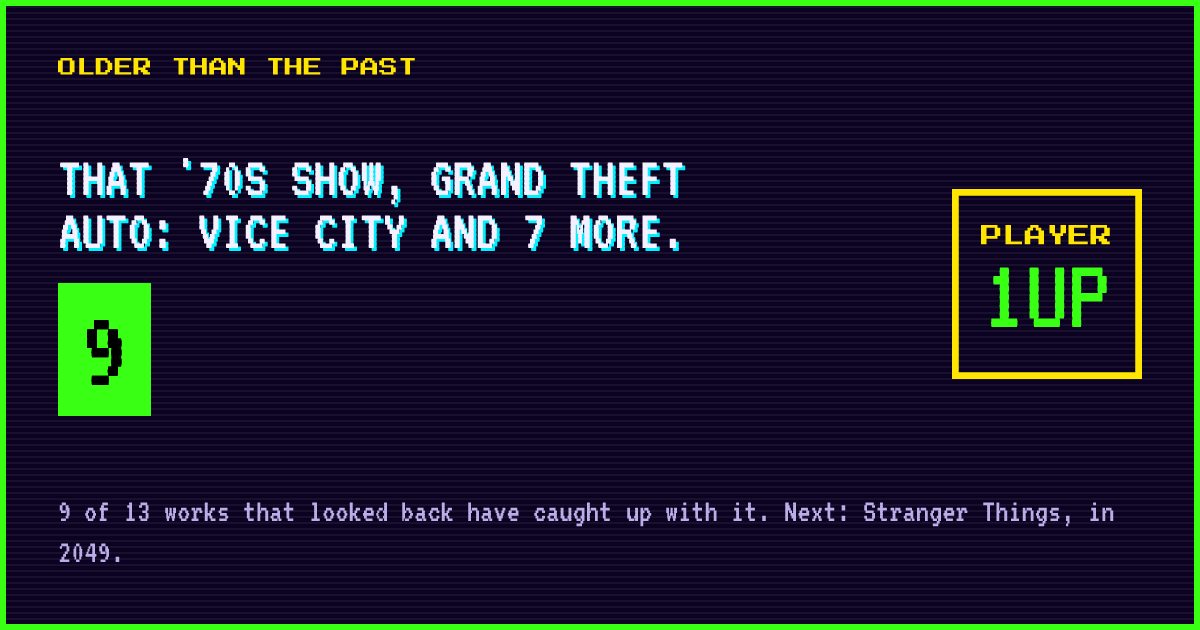
13 works that looked back
Older than the past they looked back at.
9
of 13 have caught up with their own past, as of 2026
Back to the Future looked back 30 years from 1985. In 2015 it was 30 years old itself.
Next: Stranger Things, in 2049.
Already older than their past
That '70s Show
Caught up in 2020
Fox premiered it in 1998 and set it 22 years back, in a Wisconsin basement where four years of story took eight seasons to tell. The same reach from 2026 lands in 2004 to 2007, which is now as far behind us as May 1976 was behind its first audience.
Grand Theft Auto: Vice City
Caught up in 2018
Rockstar built 1986 in 2002, 16 years after the fact, out of Miami Vice, Scarface and 113 licensed songs. Made in 2026, the same reach would have it recreating 2010 instead — a year now old enough to sell as a period, complete with its own radio stations.
Back to the Future
Caught up in 2015
Robert Zemeckis's 1985 comedy sent its teenage hero 30 years into the past, to a 1955 his parents remembered as their own youth. The film's arithmetic was never about 1955 in particular. It was about the distance between a teenager and their parents' adolescence — a gap that keeps moving.
Dazed and Confused
Caught up in 2010
Richard Linklater set his film on one day, 28 May 1976, 17 years before it was released, and had the number carved into a prop. The same reach from 2026 puts the last day of school in 2009, near enough that the freshmen being chased with paddles would be in their early thirties now.
The Wonder Years
Caught up in 2008
The show had this site's formula written into its production rule: every season is set exactly 20 years before it aired. Six seasons from 1988 covered 1968 to 1973. Premiered in 2026, that same rule would run Kevin's adolescence from 2006 to 2011.
Grease
Caught up in 1998
Grease came out in 1978 and set its senior year 20 years back, in 1958, with a 33-year-old playing a high-school senior. The same reach from 2026 lands in 2006, which means a remake's greasers would be nostalgic for a year some of its audience can still remember from school.
Happy Days
Caught up between the 1980s and the 1990s
ABC premiered it in 1974 and set it in the 1950s, in a Milwaukee built from the producers' own teenage years. Made in 2026, the same reach back lands in the 2000s, which is the decade its own nostalgia would now be about: a jukebox replaced by whatever the audience was carrying in its pocket.
American Graffiti
Caught up in 1984
George Lucas made his second film for about $777,000 and set it 11 years back, on a single night of cruising in a California town. It took over $140 million, invented the modern nostalgia picture, and did it from a distance short enough that most of the audience had lived through it.
The Great Gatsby
Caught up in 1928
Fitzgerald wrote about the summer before last. The gap is 3 years — the smallest on this site by a wide margin, and small enough that the book was reporting rather than remembering. Written in 2026, the same reach would set it in 2023.
Still to catch up
Stranger Things
Catches up in 2049
The Duffer brothers set their first series 33 years before it aired, in a 1983 of bicycles, walkie-talkies and basement Dungeons & Dragons. The show is an argument that a particular childhood is worth rebuilding in detail, and the detail is what people came for.
Mad Men
Catches up in 2054
Matthew Weiner's series opened in a 1960 its 2007 audience could still half-remember: 47 years back, close enough for parents and grandparents, far enough that the ashtrays counted as costume. The show was built on that exact distance — near enough to feel personal, far enough to look like another country.
Midnight in Paris
Catches up between the 2090s and the 2100s
Gil walks into the 1920s at midnight, 91 years behind the film that sends him there. Made in 2026, that same reach would drop him in the 1930s — a decade nobody in Paris romanticises, which is precisely the argument the film keeps making about golden ages.
Outlander
Catches up in 2285
Claire steps through the stones at Craigh na Dun and lands 202 years before the woman who left. This site measures 271 years, because it counts from the broadcast and not from her own bedroom. Made in 2026, she would land in 1755.